Handicap e Over/Under — Melhores Mercados de Apostas em Futebol 2026
 Available in US
Índice de conteúdos
- Mercado 1X2 — Análise de Margens Ocultas e Dificuldade de Ganhos
- Over/Under de golos: onde a análise estatística tem maior impacto
- Handicap Asiático: menor margem, maior complexidade
- Ambas as equipas marcam: volatilidade e valor escondido
- Dupla Hipótese e outros mercados seguros: ilusão de valor
- Mercados de cantos e cartões: nichos com menos eficiência de mercado
- Placar exacto e mercados de alta quota: volatilidade calculada
- Como escolher o mercado certo para o seu perfil de apostador
Football dominates Portuguese sports betting by a significant margin — roughly 67-72% of total sports betting volume across different quarters, with the Primeira Liga, Champions League, and La Liga consistently the most traded competitions. With that much money flowing through football markets, you’d expect bettors to have a sophisticated understanding of how those markets work. In my experience, most don’t. They bet the match result, occasionally the Over/Under, and treat everything else as exotic terrain. That’s a mistake, because the 1X2 market — the one everyone uses — typically carries the highest bookmaker margin of all mainstream football markets.
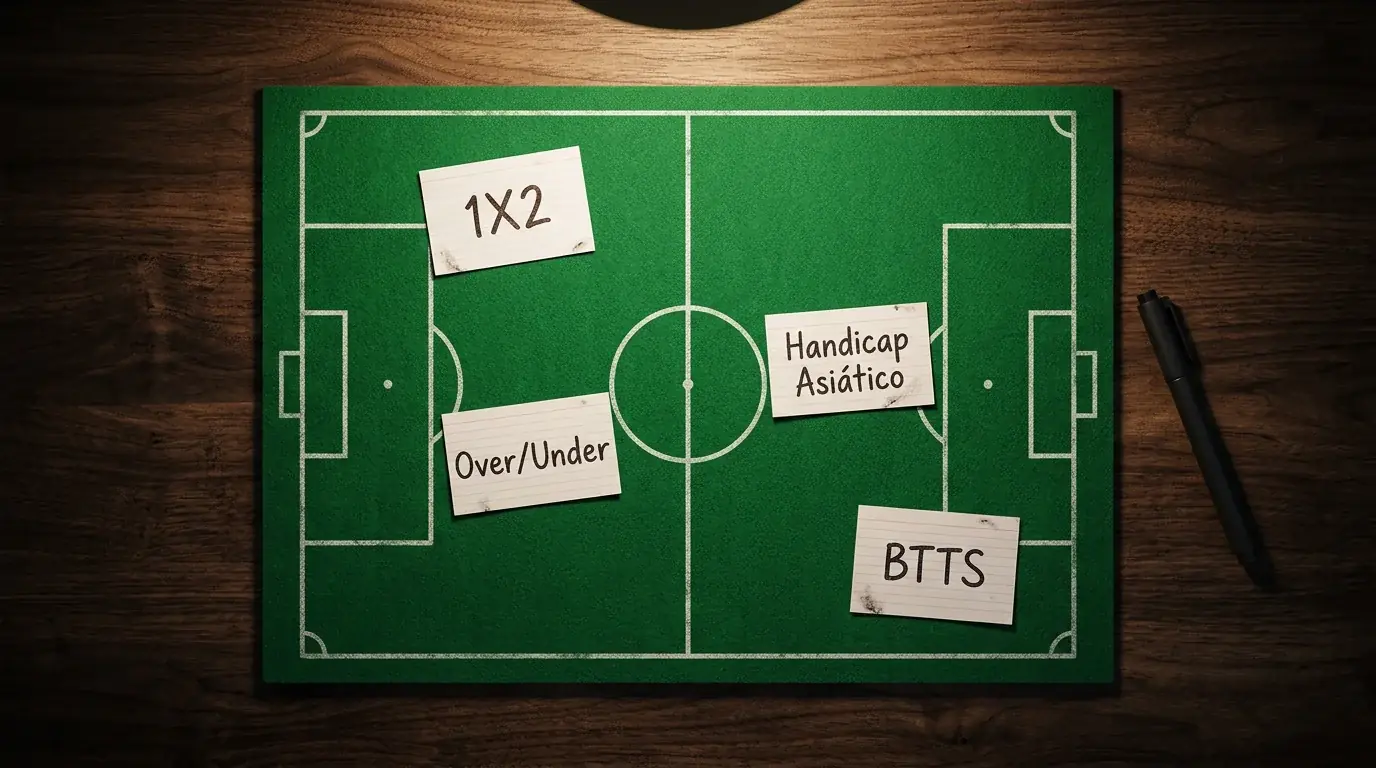
This guide covers the eight football markets you’ll encounter most often in SRIJ-regulated operators: how each one works mechanically, where the bookmaker’s margin sits, and when each market makes analytical sense to target. I’ve organized them by market complexity, starting with the most familiar and moving toward the less understood.
Mercado 1X2 — Análise de Margens Ocultas e Dificuldade de Ganhos
A new bettor in my circle once asked me why, if 1X2 is the most popular market, isn’t it also the best one? The answer tells you everything about how bookmaker efficiency works.
The 1X2 market — home win, draw, away win — is the most liquid football market, which means it gets the most bookmaker attention, the most sharp money, and the most sophisticated pricing. Precisely because everyone bets it, the margin is highest and the efficiency is greatest. Typical overround on 1X2 markets in major European leagues runs 5-8%. The bookmaker has every incentive to price this market accurately, because errors in the most-traded market are immediately exploited by professional bettors.
The draw is the outcome that historically receives the least accurate pricing. Bookmakers tend to underestimate draw frequency in matches between evenly-matched teams and in leagues with tactical defensive traditions. If you’re going to find value in 1X2, the draw is statistically the most fertile ground — but it also carries the most variance, which demands strict bankroll discipline.
Home advantage pricing is the other persistent inefficiency in 1X2 markets. The structural home advantage in football — stadium familiarity, crowd pressure, shorter travel — has been well-documented statistically for decades. But the magnitude of home advantage varies significantly by competition, stadium size, and historical data from the specific fixture. Bookmakers apply relatively generic home advantage multipliers in many domestic leagues outside the top five. Bettors with detailed match-level home performance data — not just season averages but specific venue, timing, and opponent-type data — can find edges in home team pricing that generic models miss.
The honest assessment: for the average bettor without a quantitative model, the 1X2 market is the hardest market to beat consistently. Competing against bookmaker algorithms that are continuously refined by professional betting syndicates is genuinely difficult. The markets I discuss below tend to offer better conditions for the analytical bettor.
Over/Under de golos: onde a análise estatística tem maior impacto
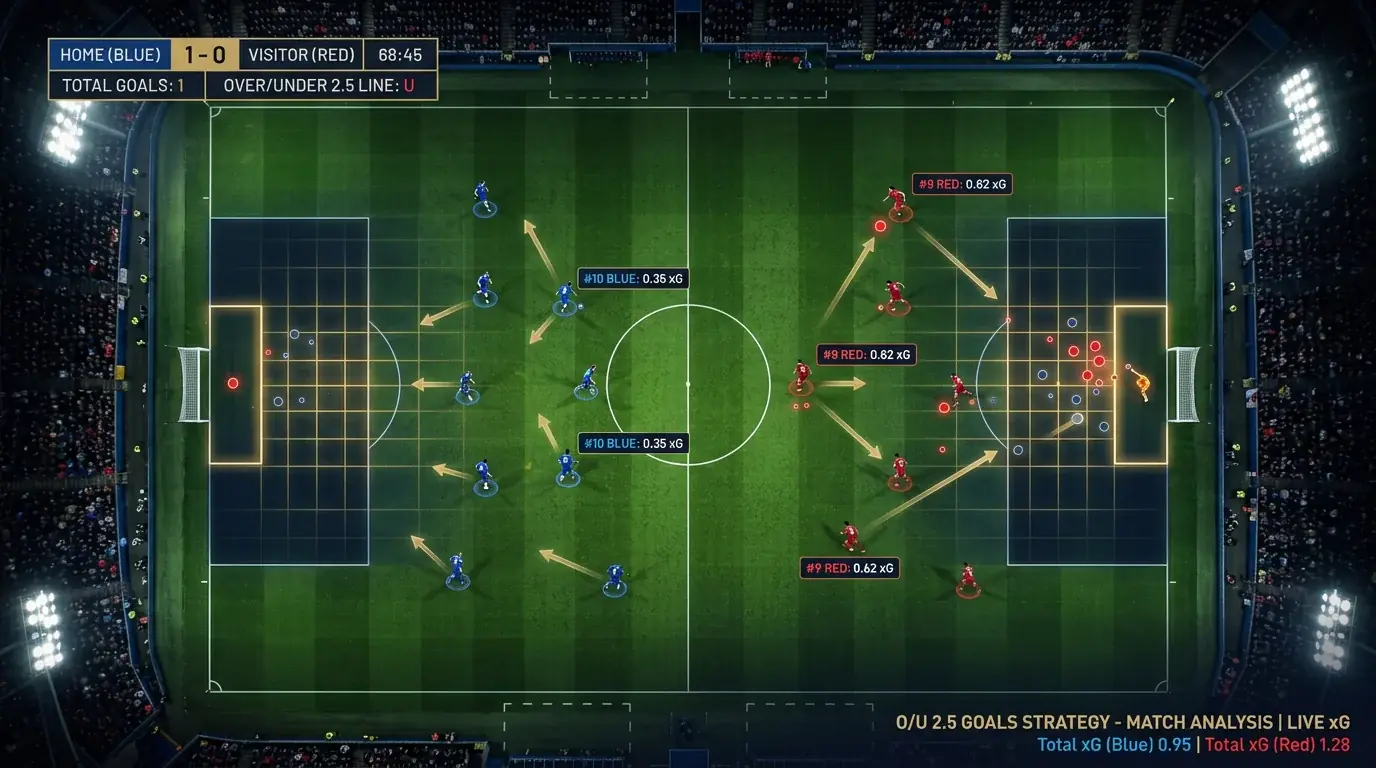
If I had to choose one market to focus on exclusively, it would be Over/Under goals. The reasons are structural. First, Over/Under markets typically carry lower margins than 1X2 — many major-league matches run at 3.5-5% overround. Second, goals can be modeled statistically with more precision than match outcomes, because goal-scoring follows a pattern (the Poisson distribution) that’s well-understood and relatively stable across competitions. Third, bookmakers invest less refinement here than in the match result market, which means edges are more persistent for bettors with solid data.
The key modeling input is expected goals (xG) — a metric that measures the quality of chances created rather than just the scoreline. A team that creates 2.1 xG per match but scores only 1.4 goals is due for positive regression; a team scoring 2.0 goals on 1.2 xG is due for negative regression. These mismatches between xG and actual goals are invisible to bettors who only look at scorelines, but they’re central to accurate Over/Under projections.
Choosing the right line matters enormously. The standard Over/Under 2.5 is priced tightly in high-liquidity matches. Over/Under 1.5 and Over/Under 3.5 receive less market attention and can offer better value, particularly in matches where your model strongly suggests a specific scoring pattern. For a deeper breakdown of how to apply xG data to these lines across different competitions, the Over/Under strategy guide goes into the full methodology.
A detail that significantly improves Over/Under betting decisions: distinguishing between xG from open play and xG from set pieces. Teams with elite set piece routines — corners routinely converted into high-quality headers, well-organized free kick situations — generate scoring threat that doesn’t show up in their open-play xG. Conversely, teams that create most of their xG from set pieces rather than open play show more variance in goal conversion, because set piece execution is noisier than open-play chance creation. Matching this distinction to the Over/Under line helps calibrate how much to trust your xG-derived projection for a specific fixture.
The timing of Over/Under bets also matters. Bookmakers set their initial lines based on season-long data and then adjust as match-specific information — team news, weather conditions, tactical reports — emerges. In the 24-48 hours before a major match, lines sometimes move away from their opening position without any public news triggering the movement. That movement is often the result of sharp Over/Under bettors hitting soft opening lines. When you see a line that has moved against the consensus expectation and you can’t identify a public reason for the move, that movement itself is information worth factoring into your analysis.
Handicap Asiático: menor margem, maior complexidade
Asian Handicap is the market that separates casual bettors from serious ones. The learning curve is real — the first time you encounter a -0.75 handicap, it genuinely looks like a typo — but the payoff in terms of lower margin and reduced draw risk makes it worth understanding thoroughly.
The core mechanic: one team receives a goal advantage (positive handicap) and the other gives one away (negative handicap), eliminating the possibility of a draw push. A -1.5 Asian Handicap on the favorite means they must win by two or more goals for the bet to win. A +0.5 on the underdog means they win if the match ends in a draw or an underdog victory.
Quarter handicaps (-0.25, -0.75, etc.) are where it gets interesting. A -0.75 handicap means your stake is effectively split between -0.5 and -1.0: half your stake wins if the team wins by exactly one goal, the full stake wins if they win by two or more, and both halves lose if the match ends level or in the opposition’s favor. This fractional structure reduces variance on close handicap lines.
The margin advantage is significant. While 1X2 markets run 5-8% overround, Asian Handicap markets on the same match typically run 2-4%. That lower cost per bet compounds over hundreds of wagers. For a bettor placing 300 bets per year, the difference between a 6% and a 3% average margin amounts to €225 per €500 average stake — money that comes straight out of or stays in your bankroll. The complete mechanics of quarter and half handicaps, and how each pays out across different scorelines, are covered in detail in the guia completo do Handicap Asiático.
Ambas as equipas marcam: volatilidade e valor escondido
Both Teams to Score (BTTS) is a binary market: either both teams score at least once, or they don’t. Simple to understand, deceptively difficult to price. The bookmaker’s margin on BTTS typically runs 4-6% in mainstream leagues, similar to Over/Under, but the modeling requirements are different.
BTTS depends on four independent scoring probabilities: the home team scoring, the home team conceding, the away team scoring, the away team conceding. A team with an excellent attack but a poor defense is a strong BTTS candidate from both sides. The key metrics to track are “clean sheet percentage” (how often a team keeps the opposition scoreless) and “scored percentage” (how often a team manages at least one goal). Teams with clean sheet percentages below 30% and scored percentages above 70% are consistently valuable BTTS targets on both sides of the market.
BTTS also shows interesting value in specific match contexts: cup matches where conservative tactics change team motivation, derbies with elevated intensity regardless of league position, and matches late in the season where teams in mid-table have nothing tactical to play for. These contextual factors don’t appear in raw statistics but matter considerably to pricing accuracy.
One under-appreciated dimension of BTTS betting is the interaction between possession style and defensive organization. High-possession teams that control matches tactically often concede fewer shots while creating more — which should lower the BTTS probability from the opposition’s side. But those same teams sometimes adopt a more open approach in away fixtures against similar-quality opposition, which rebalances the dynamic. Tracking whether a team’s BTTS “No” rate is systematically different at home versus away is a basic segmentation that most casual bettors skip but that surfaces genuine pricing discrepancies in mid-week fixtures and cup competitions where bookmakers refresh their BTTS lines with less nuance than they apply to the primary match result market.
The margins on BTTS markets can also vary between operators more than you might expect. Because BTTS receives less betting volume than Over/Under or 1X2, some operators price it with less refinement and more reliance on generic league base rates rather than match-specific form analysis. That creates periodic outlier prices — usually visible only when you compare across multiple SRIJ-licensed operators — that represent genuine value opportunities rather than bookmaker errors.
Dupla Hipótese e outros mercados seguros: ilusão de valor
Double Chance — home or draw (1X), home win or away win (12), draw or away win (X2) — exists because bettors want security. The problem is that security is always priced. A Double Chance bet eliminates one outcome from a three-outcome market, but it does so at significantly compressed odds. The bookmaker’s margin per unit of actual probability coverage in Double Chance is typically higher than in standard 1X2.
Consider: if a team has a 40% chance of winning, the draw has a 30% chance, and the away win a 30% chance, the theoretical Double Chance (1X) probability is 70%. A fair price would be 1 ÷ 0.70 = 1.43. Typical market prices for this scenario run 1.28-1.35 — pricing in 6-8% margin on a bet that feels “safe.” You’re paying more for the sense of security than for actual value. There are specific match scenarios where Double Chance does carry genuine positive EV, but those scenarios are narrow and depend on the specific implied probabilities in the line — not on the general comfort of covering two outcomes. A full analysis of when Double Chance has real value is in the guia de apostas em Dupla Hipótese.
Mercados de cantos e cartões: nichos com menos eficiência de mercado
Corners and cards markets receive a fraction of the liquidity of match result or goals markets. That lower liquidity translates directly to less bookmaker refinement and, periodically, genuine inefficiencies you can exploit if you’ve done the groundwork.
Corner markets are the more modelable of the two. Corner frequency correlates significantly with possession style, attacking press, and home advantage — all quantifiable. Teams that play high-pressing expansive football generate and concede corners at predictable rates. The key variables: home/away corner differential (home sides average 0.7-1.2 more corners than away sides in most European leagues), attacking dominance, and referee tendencies for corner awards near the box. A team averaging 6.8 corners per home game facing a team averaging 3.1 away is a clear Over on corner lines, provided the line is set conservatively.
Card markets are higher variance and harder to model. Referee assignment is the dominant variable — some referees in the Primeira Liga book at rates three times higher than the league median. Track individual referee booking rates over a minimum 20-match sample. Rivalry and relegation pressure add noise; isolate them and price accordingly. The combination of specific referee, derby context, and teams with high foul rates can produce card market opportunities with clear positive EV that the wider market underprices.
The practical workflow for corners and cards analysis: before each match week, identify fixtures where your target variables are unusually favorable. For corners — two attacking teams both averaging above-average corners in relevant home/away splits, no exceptional weather or pitch conditions affecting play style. For cards — a referee known for high booking rates assigned to a match between teams with high aggression metrics and historical card counts in their head-to-head. Cross-reference these signals with the bookmaker’s line. If the Over is priced in a range that implies lower frequency than your analysis suggests, that’s the condition for a bet. If the line has already been moved by sharp corner or card specialists, that movement itself is useful information about how the market has priced the fixture.
One final point about alternative markets generally: the efficiency gap between primary and alternative markets in any competition tends to narrow as the competition gains popularity and betting volume. Corners markets in the Primeira Liga and La Liga are now reasonably well-priced by bookmakers who have accumulated years of liquidity data on those competitions. The more persistent inefficiencies tend to be in lower-division Portuguese football, certain Scandinavian leagues, and second-tier competitions within major markets — areas where bookmaker resources for alternative market refinement are thinner.
Placar exacto e mercados de alta quota: volatilidade calculada
Correct Score and other high-odds markets (first goalscorer, half-time/full-time result) operate on a different logic. The margins are enormous — correct score markets on a typical match run 15-25% overround across all possible scores. No serious bettor would routinely target these markets expecting positive EV from a modeling approach.
The case for occasionally placing correct score bets is purely about calculated variance. These markets pay 7.00-20.00 or higher on common scores like 1-0 or 2-1. If your probability estimate for a 1-0 result is 15% and the market price implies 8.5%, you have a genuine edge — but the variance on a single bet is extreme. The only way this makes sense in a portfolio context is as a small-stake supplementary bet placed alongside your primary market wager, where the high odds offset a portion of the expected negative variance from regular betting. Never as a core strategy. Never with significant stakes.
Como escolher o mercado certo para o seu perfil de apostador
After nine years of market analysis, my practical recommendation follows a simple framework based on where you are in your betting development.
If you’re starting out: focus on Over/Under 2.5 and BTTS in two or three leagues you follow closely. The modeling requirements are accessible (basic xG data, clean sheet percentages, scored percentages), the margins are moderate, and the two-outcome structure eliminates the draw problem of 1X2. Build a 200-bet record in these markets before considering expansion.
If you have an established record and positive ROI: add Asian Handicap to your primary markets. The lower margin compounds significantly over time. Accept the learning curve on quarter handicaps — it’s worth the investment. Good knowledge of the sport can help you evaluate whether the bookmaker is correctly pricing a specific matchup, and in AH markets, that evaluation has more direct consequence than in 1X2.
If you have a quantitative modeling background: corners markets in leagues with consistent statistical patterns (Bundesliga, Eredivisie, certain Portuguese lower leagues) offer the best combination of low efficiency and modelability. The data requirements are higher but the opportunities are more persistent.
What doesn’t work as a primary strategy: chasing 1X2 in major leagues without a sophisticated model, betting Double Chance for “safety,” and treating correct score markets as a core portfolio position. The market structure of those approaches is working against you from the first bet.
A note on market selection and competition overlap. The Primeira Liga accounts for 9.8% of total football betting volume in Portugal, La Liga roughly 6.4%, and the Champions League commands a significant share of European match traffic, particularly during knockout phases. These competitions are also the most heavily traded, which means their mainstream markets (1X2, Over/Under 2.5) are also the most efficiently priced. If you’re targeting value in Portuguese or European football, the less-traded markets within those high-volume competitions — corners, cards, Asian Handicap — often offer better conditions than the primary match result market, even in competitions that receive heavy bookmaker attention.
Finally, a structural point that applies to market selection at every level: diversification across market types is protective. A bettor who relies exclusively on Over/Under 2.5 has all of their model risk concentrated in goal-scoring patterns. If the leagues they follow go through an unusual defensive phase (as European leagues sometimes do in specific seasons), their entire model underperforms simultaneously. Spreading across three or four market types — Over/Under, BTTS, corners in specific contexts, Asian Handicap — means no single market trend wipes out all activity at once. This isn’t just risk management; it’s also how you develop a more complete analytical picture of the games you’re studying.
Qual mercado de futebol tem menor margem de casa em média?
O Handicap Asiático tem consistentemente as margens mais baixas nos mercados de futebol mainstream — tipicamente 2-4% em comparação com 5-8% no 1X2. Essa diferença composta ao longo de centenas de apostas representa um custo substancialmente menor de participar no mercado e um requisito de edge significativamente menor para ser lucrativo.
O handicap asiático elimina completamente a opção de empate?
Em handicaps de meio golo (0.5, 1.5, etc.), sim — o resultado é sempre uma vitória ou uma derrota para o apostador. Em handicaps inteiros (0, 1, 2), um empate no handicap resulta em devolução da aposta (push). Os quarter handicaps (0.25, 0.75) dividem a aposta entre dois handicaps adjacentes, criando um resultado parcial em empates ajustados.
Apostas Over/Under são mais previsíveis do que apostas no vencedor?
Em termos de modelação estatística, sim. Os golos seguem a distribuição de Poisson de forma suficientemente consistente para que modelos simples baseados em xG produzam estimativas de probabilidade razoáveis. Os resultados de vitória/derrota introduzem mais variáveis táticas e contextuais que são mais difíceis de quantificar com precisão.
Em que mercados vale mais a pena fazer apostas ao vivo?
Over/Under e BTTS ao vivo oferecem as melhores condições para apostas in-play. As odds ajustam-se em tempo real com base no fluxo do jogo, mas há periodicamente desincronizações — por exemplo, quando uma equipa cria múltiplas chances em rápida sucessão sem marcar, as odds de Over podem subir momentaneamente acima do valor justo antes que o mercado corrija.
Criado pela redação de «Dicas de Apostas Desportivas».